Personal Protection Dogs are a Completely Different Level
Most people use the phrase “guard dog” to mean any dog that makes them feel safer. When people search for good guard dogs, great guard dogs, or even the best guard dogs, what they are often really looking for is peace of mind.
The problem is that guard-dog behavior and true Personal Protection Dog / Family Protection Dog performance are not the same thing—especially inside a modern home with kids, guests, deliveries, contractors, neighbors, and real daily life.
At AlpinHaus Shepherds, we built Protection Dogs 2.0 because the industry’s default model (what we’ve termed Protection Dogs 1.0) is still fundamentally rooted in the same core idea as a guard dog: territorial reactivity. It looks protective. It sounds protective. Many lists of top guard dogs are built entirely around this appearance.
But in the real world, this approach often produces chaos, liability, and false confidence.
Here’s what a guard dog is, what it is not, and why AlpinHaus Dogs are built on a completely different operating system.
What a Guard Dog Really Is
A traditional guard dog is primarily a territorial deterrent. The dog’s “job” is to protect space—a yard, a gate, a building, a boundary. This is why most articles ranking the best guard dogs focus on breeds known for territorial instincts rather than judgment or control.
The mechanism is usually simple:
• alert barking
• posturing and lunging
• repelling “intruders” the dog perceives as crossing a line
This is the core of territorial behavior: the dog’s goal is to drive the “intruder” away from what it perceives as its territory.
That sounds good—until you realize what the dog thinks counts as an intruder.
Mail carriers. Neighbors. Kids on bikes. Your friend walking in wearing a hat. A contractor entering confidently. A guest who moves fast. In other words, normal life.
And territorial barking is notoriously self-reinforcing: the dog barks, the “intruder” leaves (because they were going to anyway), and the dog learns that barking worked. Over time, even dogs once described as good guard dogs become louder, more reactive, and less discriminating.
So the guard dog becomes “effective” at creating noise and intimidation—while increasingly blurring the line between threat and everyday life.

⸻
The Hidden Problem: Reactivity Is Not Protection
Guard-dog behavior is reactive by design. Reactivity is not discernment. It’s not judgment. It’s not control. It is a dog firing its nervous system at stimuli it has learned to associate with “intruder.”
This is why many so-called great guard dogs fail families when conditions change.
Guard-dog setups tend to produce two outcomes families cannot live with:
1. Under-protection: The dog barks, postures, and then does nothing meaningful when a real threat commits.
2. Over-protection: The dog escalates on the wrong target—kids, guests, family members, or normal movement patterns.
This is not a minor issue. Aggression toward children—especially children in the home—is one of the most serious and hardest-to-remediate behavioral failures a dog can have.
A family can tolerate a loud dog.
They cannot tolerate a dog that is unpredictable in or around the home.
⸻
What AlpinHaus Dogs Are: Protection Dogs 2.0
AlpinHaus Dogs are not trained to guard property. They are trained to guard people—with a defense-first ruleset, elite control, and Real-World readiness.
Our model starts from one uncompromising premise:
A Personal Protection Dog must be a safe family companion by default—then become decisive only when required.
That is why AlpinHaus Shepherds is built on the CCV framework:
• Control: Elite handler control before, during, and after aggression
• Capability: Real-world breadth, OFF-Leash Protection, and unique advanced protection systems
• Value: Best-in-class capability-to-value for clients who want more than what even the best guard dogs can offer
This is not semantics. It’s architecture.
⸻
Defense-First Protection: The Rules of Engagement
Guard dogs are typically territory-first.
AlpinHaus is Defense-First Protection.
When a situation arises, the Dog is called into position at the handler’s left side in Elite Off-Leash Obedience. From there:
• The Dog holds space with fluent posture and handler alignment.
• If needed, Threat Deterrence is delivered through controlled bark-on-command—not frantic reactivity.
• If a threat breaches critical distance (roughly 4–5 feet) and commits with a threatening action toward the handler or the Dog, the Dog engages defensively and automatically—without requiring a scripted “attack” sequence or even a command.
This is where guard dogs and AlpinHaus Dogs separate completely.
A guard dog reacts to territory. That is a liability.
An AlpinHaus Dog makes a correct decision under stress while remaining under command control. That is an asset.
⸻
Why AlpinHaus Dogs Are So Much Better for Families
1) OFF-Leash Protection solves the real-world problem
Most leash-based “protection” exists because of trainer ceilings, not effective strategy. OFF-Leash Protection keeps the handler free, the Dog controlled, and the outcome manageable.
2) ON / OFF Switching and Post-Protection Socialization
Many guard dogs stay “hot.” AlpinHaus Dogs can switch instantly from protection to calm neutrality—then back again. This is one of the defining traits of a truly elite Protection Dog.
3) Real-World Obedience is the foundation
If a dog can bite but cannot recall, disengage, or down under pressure, you don’t have protection—you have a liability.
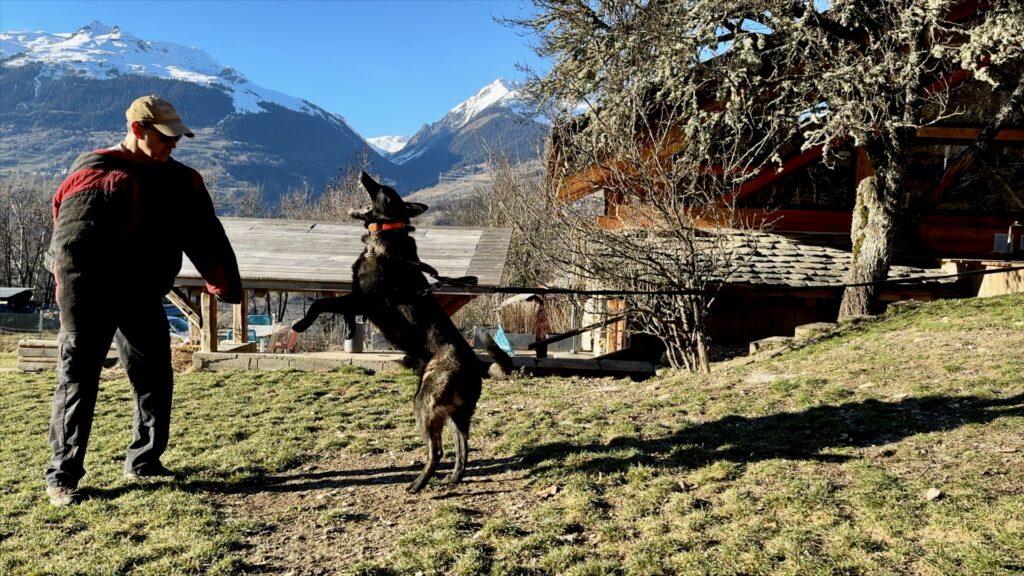
4) Five OFF-Leash Levels of Protection
Most guard dogs have one mode: territorial defense.
AlpinHaus Dogs operate across five OFF-Leash Levels of Protection: Threat Deterrence, Direct Action, Dynamic Defense, Counter-Kidnapping Capability, and X Line Two-Dog Teams.
⸻
The Bottom Line
A guard dog is a blunt instrument: loud, territorial, and reactive. Even the top guard dogs are, at best, limited deterrents—and at worst, risks to family life.
An AlpinHaus Dog is a thinking defensive system: stable in the home, socially safe in public, and capable of decisive action under real pressure—while staying under control.
If you want noise, buy a dog that barks at shadows.
If you want **true protection—truly elite protection—**with safety, judgment, and OFF-Leash control, you want Protection Dogs 2.0.
That’s what AlpinHaus Shepherds builds.
Author Credentials
Suede Michael Hussain
Founder & Master Protection Dog Trainer