Exposing Truths in the World of Trained Security Dogs for Sale
Most people assume the limitations of the Protection Dog industry exist because real life demands those limits.
That assumption is completely wrong.
Aside from the Dogs created by AlpinHaus, all trained Protection Dogs for sale fall into the realm of Protection Dogs 1.0.
Protection Dogs 1.0 are not trained the way they are because that’s what real-world threats require. They are trained that way because that is the maximum level most trainers are capable of creating.
Additionally, the clients that the Protection Dogs are being sold to have NO IDEA what they should be looking for or what really matters (and does not), nor what is really acceptable and / or what is desirable in a Protection Dog, and what isn’t.
This distinction matters more than anything else.
A leash-dependent dog, a scripted bark-and-hold routine, a narrow set of rehearsed attack pictures—these are not strategic choices. They are skill ceilings. They represent the point at which the trainer no longer knows how to safely, reliably, or consistently advance the dog further.
Protection Dogs 2.0 begins exactly where those ceilings collapse.
⸻
Breadth Before Power: Why Real Protection Is Hard
True protection does not come from intensity.
It comes from breadth under pressure.
At AlpinHaus Shepherds, protection training is deliberately built across an unusually wide operational spectrum:
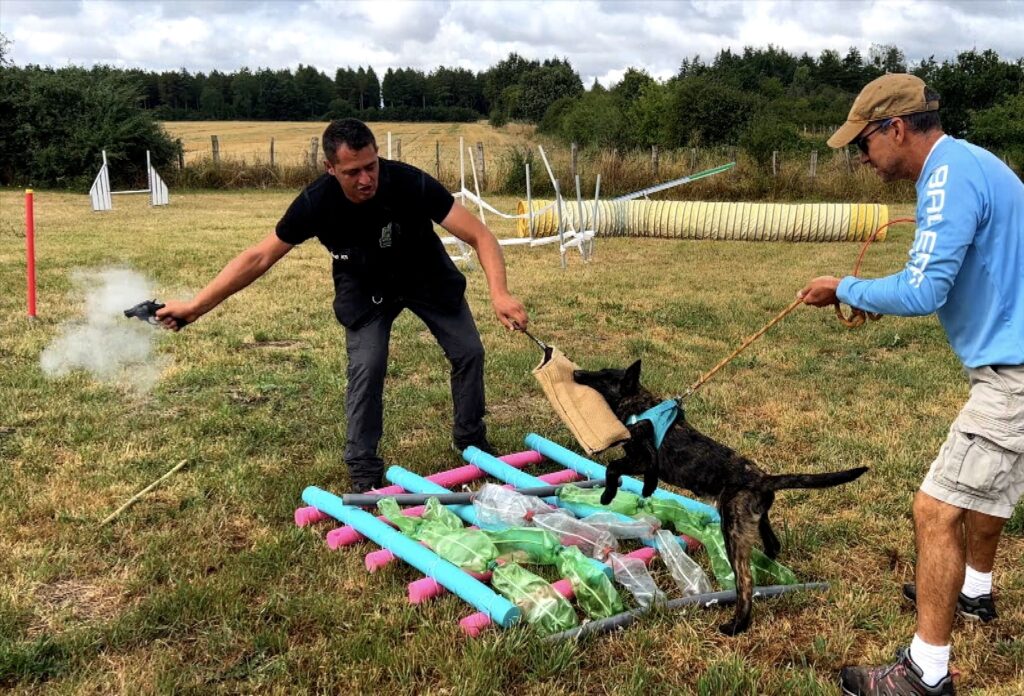
• Multiple different decoys (“bad guys” in the bite suits) used —often five or six, not one
• Decoys intentionally varied by gender, age, size, ethnicity, and movement / engagement style
• Engagements on multiple bite surfaces: sleeves, jackets, hidden civil equipment, unfamiliar materials
• Short attacks, long flying attacks, missed entries, redirects, ground fighting, and pursuit
• Engagements in homes, bedrooms, hallways, staircases, yards, public environments, and confined spaces
This is not done for show. Or for marketing.
It is done to prevent pattern recognition, which is the silent killer of real-world protection dogs.
A dog that learns patterns is not learning protection. It is learning choreography.

⸻
Stress Is Not Added — It Is Engineered
Most trainers “add pressure” by making a scenario louder or more aggressive.
That is not stress inoculation.
At AlpinHaus, stress is engineered structurally:
• Multiple decoys moving independently
• Weapons present, flashing lights, chaotic noise
• Surprise entries and non-linear threat behavior
• Environmental instability: darkness, smoke, tight spaces, unfamiliar footing
• Engagements after fatigue, not before
The goal is not to make the dog aggressive.
The goal is to see whether control and performance survives aggression. Survives distraction. Survives pressure. Survives confusion.
If obedience disappears when adrenaline appears, the dog is not elite—it is dangerous.
⸻
Control During Aggression Is the Rarest Skill in the Industry
Almost any trainer can create a dog that will bite.
Very few can create a dog that will:
• Engage fully, and is prepared to fight and WIN
• Remain command-responsive during engagement
• Disengage appropriately
• Guard appropriately
• Return immediately to calm, social behavior
This is where Protection Dogs 1.0 fail catastrophically.
They can either (hopefully) attack, or they can (hopefully) behave—but they cannot do both on demand, repeatedly, and safely.
Protection Dogs 2.0 are defined by ON / OFF Switching that works in real environments, not training fields.
This capability does not come from drills.
It comes from years of integrated development where protection, obedience, and socialization are trained as inseparable systems—not phases.
⸻
Why Bark-and-Hold, Titles, and Leashes Are Dead Ends
Traditional Bark and Hold exists because it is easier to manage than autonomy. But it is almost always a useless and dangerous skill in the real world. Almost no one trains it properly for real-world deployment.
Leash-based protection exists because it reduces liability for the trainer—not risk for the client. It also requires infinitely less professional skill for the trainer to possess.
A Protection Dog on a leash is a Dog that must be actively constrained during a threat-encounter. To do this is very difficult even for strong people. For most women – even strong ones – older people or younger people it’s simply impossible. The owner handler gets hurt in the process, often pulled to the ground, the Dog is ultimately released to go attack whoever it wants and the situation is completely out of control. If the Dog CAN successfully be restrained by its owner/handler, it is always at great difficulty and the situation is also out of control, because the owner handler is spending all of their time and energy managing a Dog in a hostile situation that can develop second by second. In this environment the owner/handler is always lagging behind the curve, never leading it. She or he is always responsive, always reactive, to the situation, never creating and directing it.
These methods persist not because they are effective, but because they are survivable for the trainer.
Once you remove:
• The leash
• The script
• The expectation that the threat will behave “correctly”
Most dogs—and most trainers—have nothing left.
Protection Dogs 2.0 removes those crutches.
That is why so few dogs in the world qualify.
View our Fully Trained Protection Dogs

⸻
The Real Standard: Can the Dog Think Under Fire?
The defining question is not:
“Will the dog bite?”
It is:
“Can the dog think, decide, and remain controllable under real and chaotic pressure?”
Protection Dogs 2.0 are not reactive weapons.
They are thinking defensive systems.
They can:
• Intercept autonomously
• Escalate only when necessary
• De-escalate without confusion
• Protect without endangering the family they live with
This level of performance is not scalable.
It cannot be mass-produced.
Which is why AlpinHaus Shepherds accepts so few clients—and why Protection Dogs 2.0 represents a permanent separation, not a trend.
View AlpinHaus Protection Training Overview
Author Credentials
Suede Michael Hussain
Founder & Master Protection Dog Trainer