The Protection Dog industry has quietly confused aggression with capability.
Many dogs marketed as good protection dogs are, in reality, only trained to display aggression, not to apply force intelligently under real conditions.
Most “protection dogs for sale” are trained to:
• React to rehearsed threats and staged scenarios
• Depend on leashes for control
• Fail under real-world pressure
Aggression looks impressive and feels powerful. Protection saves lives. The two are not the same.
This is why families searching for the best protection dogs or the best security dogs so often end up disappointed—or worse, exposed to risk they did not anticipate.
True protection requires judgment under stress, not rehearsed performance.
⸻
What an Elite, Real Protection Dog Must Do
A real Protection Dog is a thinking defensive system, not a chaotic weapon.
At minimum, a legitimately elite Protection Dog must demonstrate:
• Defense-First Orientation
The dog defends the handler. It does not merely bite threats, posture endlessly, or escalate without cause.
• OFF-Leash Protection
If a dog requires a leash to remain controlled, it is not suitable for real-world protection. Leashes compensate for training ceilings, not safety.
• Autonomous Defensive Engagement
The dog must act without commands when milliseconds matter—because real violence does not wait for verbal input.
• Immediate ON / OFF Switching
After engagement, the dog must return instantly to calm, social behavior. Without this, even so-called good protection dogs become long-term liabilities.
• Real-World Obedience
Control must hold in homes, public spaces, and chaotic environments—not just on training fields or during demonstrations.
Without these elements, the dog is a liability masquerading as security, regardless of how aggressively it performs on cue.
⸻
Why Most Protection Dogs Fail Families
Most failures fall into two predictable categories.
1. Under-Protecting Dogs
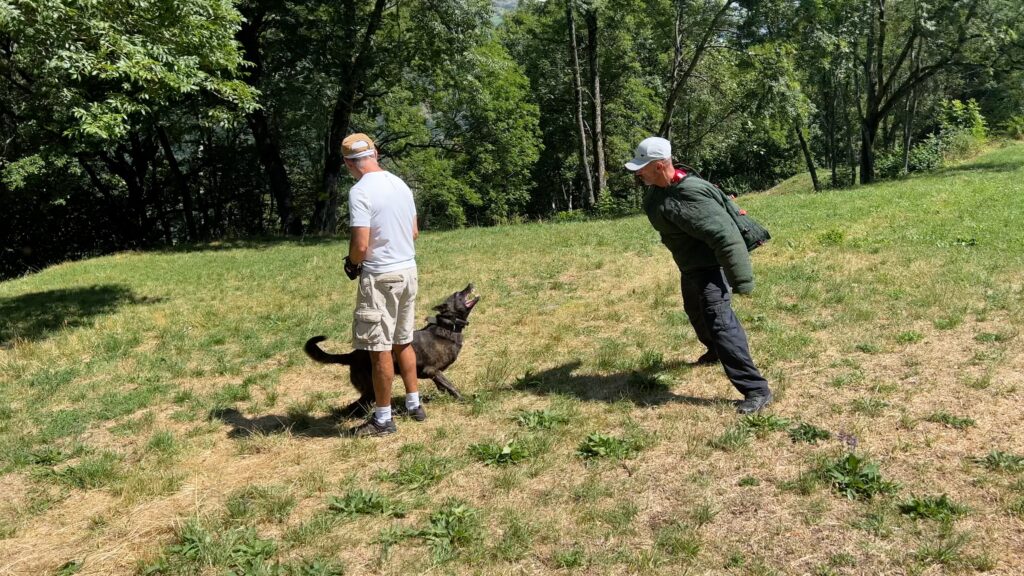
These dogs look impressive in demonstrations, videos, or sport settings—but hesitate, freeze, or disengage when real pressure appears.
Titles, certifications, and marketing language often convince buyers they are purchasing one of the best protection dogs, yet when reality intrudes, these dogs lack the defensive clarity required to act.
2. Over-Protecting Dogs
These are the most dangerous dogs in the industry.
Poor control, unstable nerves, and unreliable judgment make them unsafe around children, guests, and normal life. Many dogs marketed as best security dogs fall into this category—aggressive enough to intimidate, but not controlled enough to trust.
Both outcomes stem from the same flaw:
Training aggression without judgment.
⸻
Protection Dogs 1.0 vs. Protection Dogs 2.0
The industry’s default model—what we call Protection Dogs 1.0—is not limited by real-world requirements. It is limited by trainer capability ceilings.
Protection Dogs 2.0 represent a complete redefinition:
• Control before, during, and after aggression
• OFF-Leash Protection as a requirement, not an option
• Defense-First engagement logic
• Integrated obedience, protection, and socialization from puppyhood
• Genetics as the foundation from which traits are responsibly shaped—not a rigid constraint
This is not incremental improvement.
It is a structural redesign.
It is innovation.
And it is the difference between dogs that merely look protective and dogs that actually belong in conversations about the best protection dogs in the world.

⸻
Why “For Sale” Is the Wrong Frame
A real Protection Dog is not a retail product.
It is the result of:
• Years of development
• Real-world stress conditioning
• Owner-specific pairing and integration
Dogs trained quickly, cheaply, or generically cannot deliver real protection—no matter how convincing the marketing or how often they appear on lists of good protection dogs.
Security is not a commodity.
Protection is not a shortcut.
⸻
The Question You Should Be Asking
The correct question is not:
“Do you have protection dogs for sale?”
It is:
“Can this dog defend my life, remain safe with my family, and stay controllable under real violence?”
If the answer is not a provable yes, walk away—no matter how aggressive the dog looks or how confidently it is marketed as one of the best security dogs available.
⸻
Final Thought
True protection is calm, controlled, and quiet—
until it isn’t.
Anything else is theater.